
lagos_street_600

New data centre and enhanced cloud services planned for LagosData Centres & Networks

New data centre and enhanced cloud services planned for Lagos

It’s a major news day for data centre developments in Nigeria, and specifically Lagos, a city for which two leading names in Africa, Equinix and Rack Centre, have just announced big data centre and cloud service plans.

Digital infrastructure company Equinix has announced its intention to open its latest high-performance data centre in the city. The US$22 million investment in LG3, as it will be known, marks the first phase of what is described as an ambitious investment plan involving around US$100 million aimed at transforming Africa’s digital landscape over the next two years.

Set to open in Q1 2026, the new site will deliver vital new infrastructure to Nigeria empowering local businesses to scale, while drawing international companies to the country in this strategically positioned hub for global connectivity.

The addition of the new LG3 data centre in Nigeria also brings the incorporation of Equinix Fabric into the metro, enabling businesses to securely connect their physical and virtual infrastructure to cloud service providers, partners, and other companies to other Equinix locations all around the world.

Equinix Fabric is a network-as-a-service platform that delivers private, secure, and on-demand connectivity across hybrid multicloud environments. 

Since entering the African market in 2022, Equinix says it has expanded its presence in key African markets including Nigeria, Ghana, and Côte d’Ivoire. Last year the company also opened its first data centre in Johannesburg, South Africa.

Meanwhile Rack Centre, a Tier III carrier and cloud-neutral data centre, has announced the launch of EdgeNext’s content delivery network (CDN) and cloud hosting services in Nigeria, hosted at Rack Centre’s facility in Lagos. EdgeNext is a global edge cloud platform specialising in CDN, cloud hosting, and edge computing solutions.

EdgeNext says its expansion into Nigeria addresses growing demand by improving content delivery and cloud hosting efficiency, ensuring fast and stable application performance, and empowering businesses to scale more effectively across the region.

EdgeNext adds that its global acceleration network enables smoother, lower-latency digital experiences for video, social media, and e-commerce platforms, serving Nigerian end users. At the same time, its flexible cloud hosting resources help small and medium-sized businesses and developers to deploy services quickly, reduce IT costs, and accelerate their digital transformation.

Recognising Nigeria’s thriving gaming community, EdgeNext is also developing gaming cloud solutions that deliver low-latency, high-concurrency acceleration capabilities for mobile, PC and cloud gaming.

Looking ahead, EdgeNext say it is committed to driving the adoption of edge cloud computing in Nigeria, supporting the development of smart cities, fintech innovation, digital education, healthcare solutions, and other applications critical to the country’s economic transformation.

Rack Centre says its 13.5MW campus hosts over 73 carriers, ISPs, and network operators. The recently launched LGS2 facility achieves a design power usage effectiveness (PUE) of 1.35 using sustainable energy sources and provides direct connectivity to every subsea cable landing on Africa’s Atlantic coast.

Source: Developing Telecoms
IMG_9898.JPG-1140x815

Ai Everything MEA Egypt 2026 Kicks Off in Cairo

Technology leaders, investors and government officials gather in Cairo today as AI Everything MEA Egypt 2026 gets underway.

Cairo – Ai Everything MEA Egypt 2026 kicks off today in Cairo, bringing technology executives, startup founders, investors, policymakers, and engineers under one roof for two days of discussions focused on artificial intelligence.

The event runs through Thursday, February 12, at the Egypt International Exhibition Center, drawing participants from more than 60 countries.

Organized by GITEX GLOBAL and hosted by Egypt’s Ministry of Communications and Information Technology in partnership with the Information Technology Industry Development Agency (ITIDA), whose CEO Ahmad Elzaher gave the opening address. The summit reflects Egypt’s push to expand AI adoption across its economy. 

The summit aligns with the Egyptian government’s National Artificial Intelligence Strategy 2025–2030, which places emphasis on digital infrastructure, computing power, and wider use of AI in both public institutions and private industry.

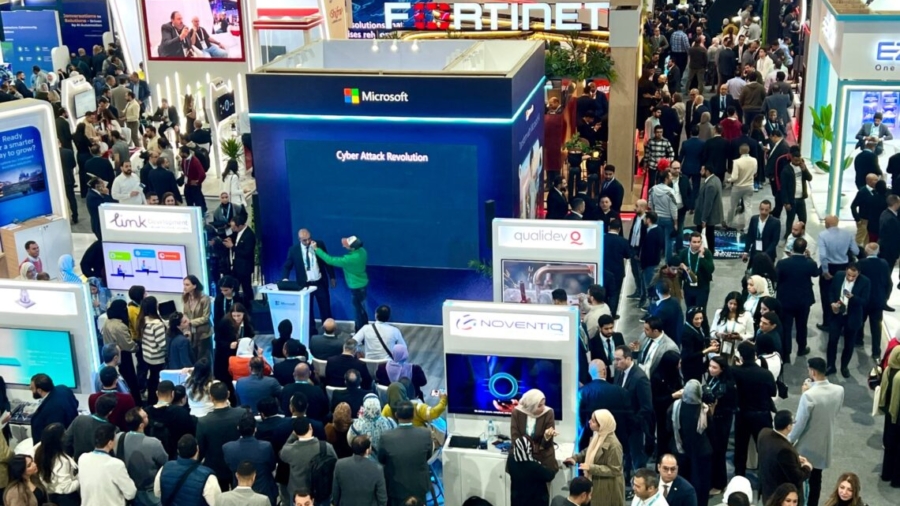
Major tech giants are present, including Cisco, e&, Microsoft, Novomind, Logitech, Barq Systems and Capgemini, alongside regional startups and enterprise technology providers. Executives and technical teams are taking part in panels, closed-door meetings, and exhibition showcases throughout the venue.

Sessions will focus on AI deployment across financial services, cybersecurity, cloud systems and data center infrastructure, with panels addressing fraud detection, risk monitoring, network security and regulatory compliance.

Semiconductors will also be a central component in these discussions, particularly access to advanced chips, supply chain resilience and computing capacity. Additional sessions cover intelligent connectivity, digital health, enterprise AI and quantum computing.

On the Main Stage, discussions today during the Sovereign AI Summit include a panel on “Human-Centric AI: Power, Responsibility and the Global South,” examining governance, equity, and the role of emerging economies in shaping AI standards. The biggest question that this panel will examine is what responsibility AI builders carry as models move faster than regulation. 

Also at the exclusive Sovereign AI Summit, participants will have access to a high-level government discussion between Dr. Abdulaziz Al Malik, Saudi Arabia Deputy Minister for Research and Innovation Ministry of Environment, Water and Agriculture alongside Huda Alwahidi Palestine Deputy Minister Ministry of Telecommunications and Digital Economy covering how to protect sovereign AI when the current global systems are not stable.

Later, “Africa’s AI Leap: Turning Local Innovation into Global Platforms” brings together Michel Rogy of the World Bank, Akua Gyekye of Microsoft Africa, and France 24 presenter Julia Sieger to discuss scaling African innovation internationally.

Another key session, “AI’s Energy Bill,” explores how governments across Asia and Africa deploy AI systems for climate resilience, water and energy management, disaster response, and urban planning, featuring Golisitan Radwan of the United Nations Environment Program.

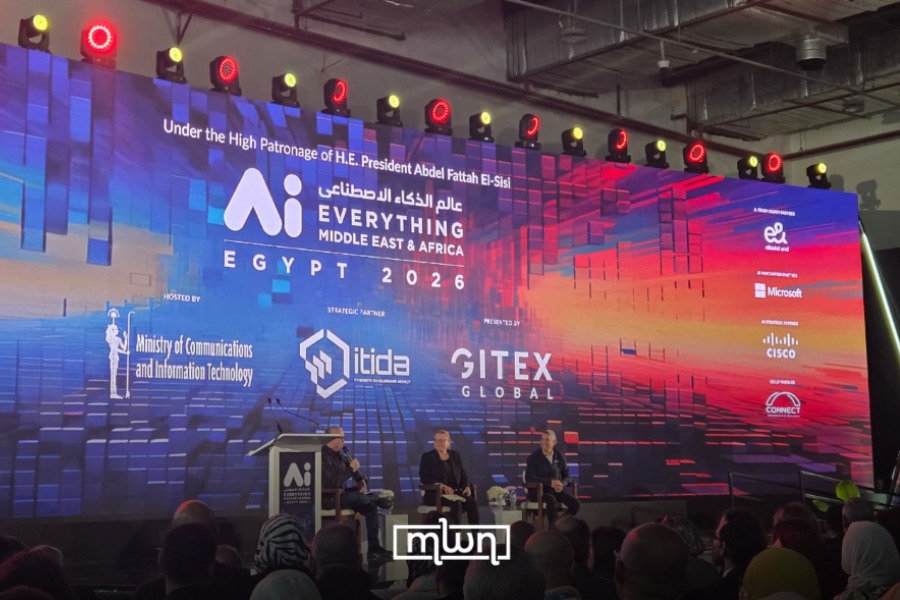
Speakers take part in a panel discussion at AI Everything MEA Egypt 2026 in Cairo.

On the AI Academy Stage, a featured session titled “AI from Strategy to Impact: Egypt’s Next Chapter” focuses on the country’s transition from policy planning to implementation under its National AI Strategy.

The discussion brings together Dr. Huda Baraka, National AI Lead and Founding Director of ECRAI, Michel Rogy of the World Bank, and Engineer Mahmoud Badawi, Assistant Minister for Digital Transformation, to examine how Egypt is moving from ambition to execution in its digital transformation agenda.

On the Growth Stage, Microsoft is presenting “Operate Anywhere: Microsoft First Party AI in Disconnected Containers with Azure Local,” where Cloud and AI Specialist Yara Maher outlines how disconnected container environments are being deployed for customers in Egypt, particularly in sovereign and infrastructure-sensitive scenarios.

Another AI Lab session, led by Nadine Khoukaz, AI Business Solutions GTM Lead for Microsoft’s multi-country cluster, examines co-pilots and agents, focusing on production economics, latency and governance, and how Microsoft’s AI stack translates models into real-world enterprise applications, including GitHub Copilot integrations.

As the summit unfolds today and tomorrow, the focus remains on practical implementation, infrastructure readiness and how AI systems are being integrated into large-scale operations across the region. 

Source: Oumaima Moho Amer

paratus

Paratus Activates 2,000 km Fiber Route Linking Mombasa to Goma, Boosting East African ConnectivityRest During Working Hours

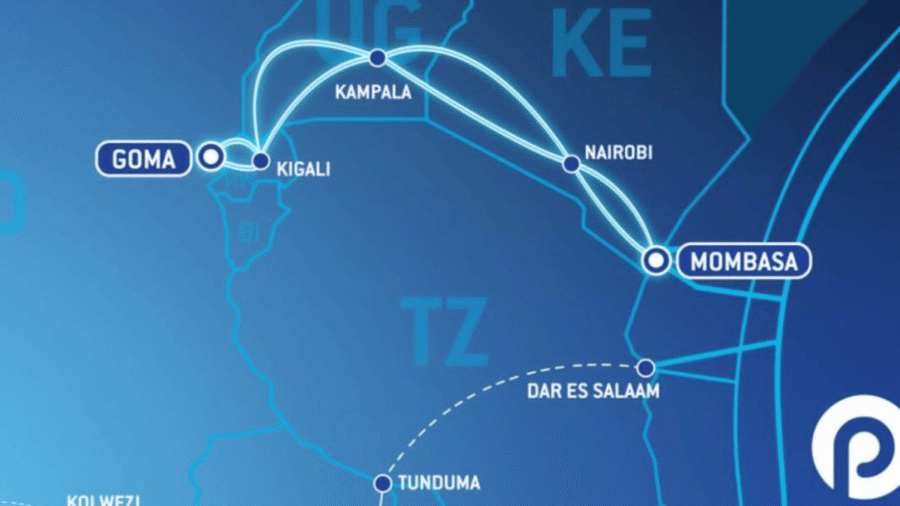
Pan-African telecommunications and network services provider Paratus Group has switched on a major new fiber route in East Africa, directly connecting Mombasa on the Kenyan coast to Goma in the eastern Democratic Republic of Congo (DRC) through a protected terrestrial network.

The newly activated 2000 km G2M (Goma-to-Mombasa) fiber route runs via Kigali (Rwanda), Kampala (Uganda) and Nairobi (Kenya), with direct interconnections into key data centers in each city. Now live and already carrying traffic for its first wholesale customers, the route delivers resilient, high-capacity connectivity designed specifically for carriers, ISPs and enterprise clients operating across borders.

The launch significantly strengthens the Paratus Group’s East African footprint, creating a continuous, fully integrated regional network that links inland markets directly to global subsea cable capacity on the coast.

In partnership with ROKE TELKOM in Uganda and MoveOn Telecoms in Kenya, Paratus is fully licensed in all East African countries through its subsidiary operating companies, Paratus Rwanda, Paratus Uganda and Paratus Kenya. The new G2M route complements the Paratus LEO footprint in Goma, Rwanda, Uganda and Kenya.

For businesses and service providers in eastern DRC and neighbouring countries, this means faster access to international networks, improved reliability and lower latency – opening the region to greater digital participation and growth.

The new route complements the Paratus Group’s broader East-West fibre backbone, which stretches from Maputo to Swakopmund and interconnects with the Equiano subsea cable, ensuring low-latency, high-capacity redundancy between Africa and Europe. Together, the networks position Paratus as one of the few operators offering seamless, cross-continental and regional connectivity through a single provider.

“This is far more than another fibre link – it’s a new digital highway for the region. By creating a protected route from the coast all the way into Goma, we’re giving operators and enterprises direct, reliable access to global capacity. It dramatically improves resilience and performance, while opening new commercial opportunities across Kenya, Uganda, Rwanda and the DRC. Our strategy has always been about connecting the dots across Africa with quality, contiguous infrastructure. The G2M route strengthens everything we’ve already built in East Africa and makes Paratus the natural connectivity partner for businesses that operate across borders.”

– Martin Cox, Chief Commercial Officer, Paratus Group

With a population of more than 200 million people and one of the continent’s fastest-growing regional economies, East Africa is experiencing rapid expansion across sectors including fintech, manufacturing, mining, energy, agriculture and ICT. Demand for secure, enterprise-grade connectivity, cloud and managed services is accelerating accordingly.

Through its suite of solutions – including dedicated internet access, cloud, data centre services, managed networks and cybersecurity – Paratus is providing the digital foundation to support this growth and enable trade and transformation across the region.

“Digital infrastructure today is as critical as traditional trade routes were in the past. We’re building the networks that make modern commerce possible – and this new route is a key part of that future.”

– Martin Cox, Chief Commercial Officer, Paratus Group

Source: TechAfrica News